You're trying to pivot. Maybe it's your third industry. Maybe you're moving from engineering to product, or product to strategy, or corporate to startup. You know — with real clarity — that your experience is genuinely relevant. The skills genuinely do transfer. You've done the self-work of mapping it out.
And the recruiter rejects you in 7 seconds. Every time.
This is the central frustration of the career change in 2026: the gap between what you can do and what you can prove you can do on paper has gotten wider, not narrower. The filters are more literal. The recruiters are busier. "Close enough" used to get an interview. Now it gets a pass.
Career-change threads on r/careerguidance, r/jobs, and Quora have the same shape every week: "I have 10 years of X experience trying to move into Y. My background is clearly relevant. I can't get past the resume screen. What am I doing wrong?"
The answer is rarely what the career-change industry tells you.
The standard advice is broken
Open any "career change at 35" article and you'll find variations of:
- Focus on transferable skills. Rewrite your resume to emphasize skills that apply to the new role.
- Use a functional resume format. Put skills at the top, downplay chronology.
- Take a stepping-stone role. Accept a pay cut to get your foot in the door.
- Get a certification. Signal to employers you're serious about the pivot.
- Network your way in. Don't rely on cold applications.
Each piece has a specific failure mode:
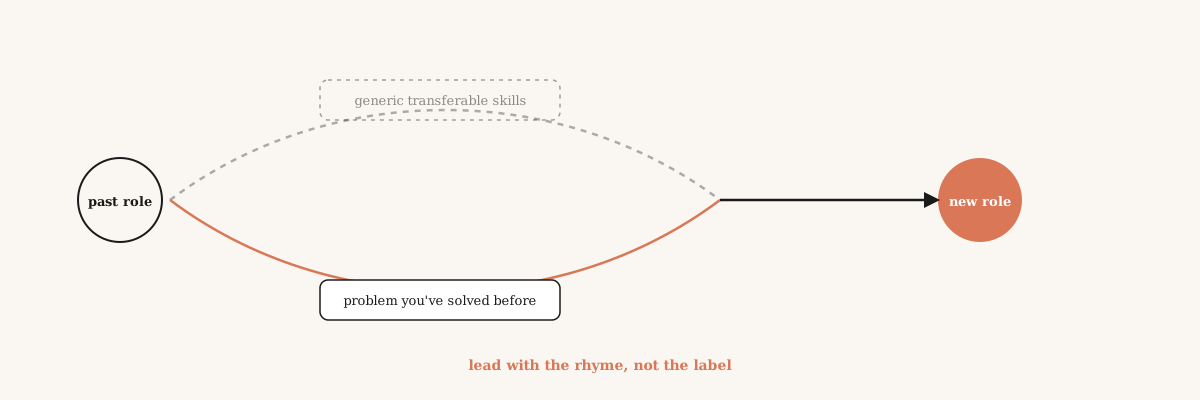
- Transferable skills advice pushes you toward generic framing. "Leadership, communication, analytical thinking" applies to everyone. The more abstract your skills framing, the less distinguishing it is.
- Functional resumes get flagged by ATSes as suspicious and rejected by recruiters as "hiding something." Industry preference strongly favors chronological.
- Stepping-stone roles often mean a 30–50% pay cut and 2 years of "proving" yourself before you get back to where you were. The math rarely works.
- Certifications signal effort but don't substitute for experience. A Google UX certificate doesn't outweigh zero professional UX work on your resume.
- Networking is correct but takes months — and you're probably already in crunch mode.
And even when you do all five, the underlying problem persists: a 7-second resume scan cannot tell whether your experience is "relevant" or "irrelevant." It can only pattern-match against what the role says it wants. If your last job doesn't look like the next job, the scanner moves on.
The deeper problem: the frame of "transferable skills"
"Transferable skills" is the wrong unit of analysis.
The phrase implies you take your existing skills and carry them into a new context. What recruiters actually need, in order to hire you, is to see:
- A specific problem in their world that you have already solved
- In a context that maps recognizably to their context
- With a result that indicates you'd solve their version of the problem the same way
That's not a "transferable skill." It's a translated experience. The work is not to list abstract competencies that apply to both jobs. The work is to find the specific situations in your past that rhyme with the specific situations in the target role, and tell those stories concretely.
A different approach: the "problem rhyme" framework
Here's the framework that actually works for pivoters. It has three steps.
Step 1: Find the top 3 problems the target role solves
Read the job description carefully. Not the skills list — the problems. What is this person actually hired to do? Usually:
- One main operational problem (build X, scale Y, reduce Z)
- One cross-functional problem (align these teams, manage this stakeholder relationship, drive this change)
- One strategic problem (figure out whether to do A or B, design the next phase of C)
Write these down in plain English. Not "strong analytical skills." More like: "Figure out whether to build our own payment processing or partner with Stripe, and convince engineering and finance of the answer."
Step 2: Find the top 3 problems you've solved in your past that rhyme
For each of the target problems, find a specific past experience that rhymes with it. Not generically — specifically.
The test: could you tell a recruiter, in 90 seconds, a story with:
- The problem you faced
- The specific decision you had to make
- What you did
- The result (ideally quantified)
If you can tell that story and the skeleton of the story rhymes with the target role's skeleton — you have a transferable experience, not just a transferable skill.
Step 3: Rewrite your resume to lead with those stories
This is where most pivoters go wrong. They write abstract bullets: "Led cross-functional initiatives." Meaningless. Nobody hires from meaningless.
Lead with specific, quantified stories in your top bullets:
"Led the build-vs-buy decision for our payments infrastructure, evaluating Stripe, Adyen, and in-house. Presented to exec team and secured alignment on partnership approach; reduced integration timeline from 9 to 4 months and saved $1.2M in projected build costs."
That bullet is pivot-proof. It doesn't claim you're a product manager if you weren't — it shows you did the work a product manager does. The hiring manager reads it and thinks: "She's done this before. She'd do it for us."
How to structure the pivot resume
Don't use a functional format
Use reverse chronological. Recruiters and ATSes prefer it. Fighting this loses.
Do rewrite your summary
One sentence. State your pivot clearly. Not hidden.
Bad: "Experienced operations leader with strong analytical skills and cross-functional expertise."
Good: "Operations lead for 8 years with deep experience in scaling logistics and vendor management; pivoting into product management to work on the operational problems I've been solving from the other side."
The second version tells the recruiter exactly what you are and what you want. The "pivoting into X" phrasing is not a disadvantage — it's a statement of intent that makes the rest of the resume legible.
Do lead with problem-rhyme bullets on your most recent role
In your current or most recent role, the top 3 bullets should be specific stories that rhyme with the target role's problems. Not every bullet. The top 3.
Your other bullets can still describe the work you actually did in your existing function. The top 3 exist to create immediate relevance.
Do include a "selected projects" or "independent work" section
If you've taken certifications, done freelance work, worked on side projects that demonstrate the new function — surface them prominently. A pivot resume with 0 projects in the new direction is a harder sell than one with 2–3, even small ones. Recruiters read this as "she's been moving toward this already."
Do cut unrelated experience aggressively
Your 2009 role at your first company? One line. Your second-most-recent role that's irrelevant to the pivot? 2 bullets max, focused on the one rhyming element. The pivot resume is shorter than a standard resume by about 30%, because you're cutting the bulk of your prior career down to the rhymes.
Cover letters for pivoters
The cover letter is where pivots are won or lost. Recruiters who skim a pivoter's resume default to "no," but a specific, well-argued cover letter can reverse that default.
The three-paragraph pivot cover letter
Paragraph 1 (the setup): Name the role, name the company, state the pivot.
"I'm applying for the Senior PM role. I've spent 8 years in operations at growth-stage SaaS companies. This role is the one I've been quietly building toward — it's where the operational problems I've been solving from the outside become the operational problems I'd solve from the inside."
Paragraph 2 (the rhyme): One concrete past experience that rhymes with the role's main problem.
"Your JD mentions building the payments roadmap. At [previous company], I led the operational side of that same decision — evaluated Stripe vs. Adyen vs. in-house, worked with our engineering team on integration timelines, and managed the executive alignment. We picked Stripe. I know what the product side of that decision looks like from the other seat."
Paragraph 3 (the close): State what you bring that a non-pivoter wouldn't.
"A hire with a straight PM background will get the craft. What I bring is an operator's intuition for what actually breaks at scale — which is what your roadmap will need when the payments partnership hits month 6."
This version acknowledges the pivot, argues for it with specifics, and closes with a differentiated value proposition. It's substantially harder to reject than a generic "I'm pivoting and here are my transferable skills" letter.
When the stepping stone is actually right
Sometimes the pivot really does require a step down. A few signals that it might:
- The target function requires specific credentials (law, medicine, some engineering disciplines).
- Your pivot crosses two axes at once (e.g., changing industries AND functions). One at a time is easier.
- You have zero concrete examples to rhyme with the target role's problems. In this case, get a stepping-stone role to build those examples first.
If those aren't true — if your rhyme stories are strong — a full lateral move is viable, and the stepping-stone advice is probably wrong for you. Most pivoters underestimate how legitimately transferable their concrete experience is, and overestimate the need for a step down.
Where shortlisted.site fits
The single most valuable thing for a pivoter is a tool that reads your resume the way a smart hiring manager would — looking for the rhyme, not the exact match.
We built shortlisted.site to do exactly that. Our fit analysis specifically surfaces transferable-experience mapping: given a target role, it scans your resume for the experiences that rhyme with the role's top problems, and tells you which of those experiences to lead with in your resume and cover letter.
For pivoters, this is transformative. Instead of guessing which 3 of your past experiences to feature, you get a data-informed read on which experiences will read as relevant to the hiring manager for this specific role. Then the tailored resume and cover letter we generate lead with those experiences, framed in the target role's language, with the "pivoting into X" framing handled crisply.
Our pivoter users consistently report the same arc: their interview rate triples once they stop trying to hide the pivot and start leading with the rhyme.
You can upload a resume and try a fit analysis on any role in under two minutes. No credit card. Try it here.
Career pivots fail on paper far more than they fail in interviews. Once you are in the room, your past experience can usually speak for itself. The problem is getting into the room.
Stop listing transferable skills. Start telling transferable stories. Find the 3 problems in your past that rhyme with the 3 problems in the target role — specifically, concretely, with numbers — and lead the resume with those.
Name the pivot in your summary. Argue for it in your cover letter. Cut everything from your resume that doesn't serve the rhyme. Skip the functional-resume trap. Avoid stepping-stone roles unless you really have no rhymes to lead with.
You are not pivoting from irrelevance. You are pivoting with 10+ years of real experience that actually maps. The work is to make that mapping legible in 7 seconds.