It is April 2026. You were laid off in early 2025. The job market took longer than you expected. You traveled a bit, took a course, did some freelance work that did not become a business, then came back to the search. The gap on your resume now reads as fourteen months. You open the resume to write something in that empty space and realise you do not know what to call it.
This is the most-searched gap-year question on r/jobs and r/careerguidance right now. It is more common than the firing question and harder to answer because the labels themselves keep shifting. "Career break", "sabbatical", "personal project", "consulting", "exploration phase" — every recruiter has a different reaction to each one, and the wrong label can be worse than no label.
Here is what works in 2026, what to avoid, and how to keep LinkedIn consistent so the gap looks deliberate from every angle.
How recruiters actually read a gap
A 2026 gap year is no longer the disqualifier it was in 2018. The mass layoffs of 2023 to 2025 changed what recruiters expect to see. In a decent share of resumes crossing a recruiter's desk now, there is some kind of gap in the last three years. The gap is no longer surprising.
What is still disqualifying is one of three patterns:
- An unexplained gap. No label, no entry, just a date jump from "exited Acme Corp, March 2024" to "joined NewCo, May 2025". This reads as either hidden or as the candidate's history being unstable.
- A vague label that hides activity. "Personal projects" with no detail, or "consulting" with no clients listed, reads like a euphemism. Recruiters assume the worst.
- A defensive narrative that takes up half the resume. Long paragraphs explaining why the gap was actually productive. Anything that performs effort to convince the reader is read as weakness.
Recruiters are not looking for a clean record. They are looking for a candidate who can describe the last twelve months in one line, in language that matches the rest of the resume.
The labels that work in 2026
Use one of these. They are not interchangeable. Each implies a different shape of activity and reads differently to recruiters.
Career break
"Career break, March 2024 - April 2025" One line of context optional.
Use this when the gap was deliberate and you do not want to itemize what happened in it. It is the most neutral label. Recruiters in 2026 generally accept it without a follow-up question on the resume itself, though they may ask about it in interview. It is the right label after a layoff if the time was used for a mix of rest, travel, family, and search.
Sabbatical
"Sabbatical, May 2024 - August 2025" Optional one-line context: e.g., "Travel and self-directed study (machine learning, focused on production deployment)."
Use this when the gap was clearly chosen rather than imposed. Sabbatical implies the previous job was completed on your terms and you took the break voluntarily. Do not use this label after a layoff or a firing — the word does not match the underlying situation and recruiters who realize the mismatch lose trust in the rest of the resume.
Independent consulting / freelance
"Independent consultant, January 2024 - March 2025" "Clients: [Company A], [Company B], [Company C]. Engagements ranged from 3 to 8 weeks, focused on [domain]."
Use this only if you actually did consulting and you can name at least two real clients. If the consulting was one client for two months and then nothing for a year, do not use this label for the full gap. The recruiter who asks "tell me about your consulting practice" and discovers it was one engagement will read the rest of the resume more skeptically.
Caregiver / family leave
"Family leave, June 2024 - November 2025" Optional one-line context: e.g., "Primary caregiver for a parent during a serious illness."
Use this when caregiving was the actual reason for the gap. It is legally protected as a category in many jurisdictions and culturally well-understood. Do not stretch it. If you spent four months caregiving and ten months job-searching, label the four months and find a different label for the rest.
Self-directed learning
"Self-directed study, September 2024 - present" Optional one-line context: e.g., "Focused on data engineering with hands-on projects in dbt and Airflow; published [link to GitHub]."
Use this when the gap was specifically about retraining for a pivot. Make the projects real and link them. A "self-directed study" line with no portfolio behind it reads as a euphemism for unemployment.
Job search
This is the label most candidates try to avoid. In 2026 it is mostly fine to use, with one caveat.
"Active job search, May 2024 - present"
It is fine if the search is recent (under six months) and if it follows a layoff or a deliberate exit. It becomes a problem if the search has been going on for more than a year, because at that point recruiters wonder why nothing has landed. If the search has gone on more than a year, use "career break" or one of the other labels and bring up the search context only in the cover letter or interview.
What to leave out
Do not list "various personal projects" with no detail
This is the single most-flagged gap label by recruiters. It signals that something happened that the candidate does not want to itemize. If the projects are real and worth mentioning, name them. If they are not worth mentioning, use a different label entirely.
Do not invent a company name
If you did some freelance work, do not list it as "Founder, [Made-Up LLC Name]". Recruiters and background checks notice the entity does not have a website, employees, clients, or a tax record. The made-up company is worse than the gap.
Do not stretch dates
If you exited a role in March 2024 and started looking in June 2024, do not list the previous role as "Acme Corp, 2020 - mid-2024". The verification call will return March 2024 and the date stretch will look intentional. Even small stretches damage trust.
Do not list "thinking time" or "reflection" or "introspection"
These read as filler. Use a real label or none at all.
Do not over-narrate in the cover letter
The cover letter explanation of a gap, if you include one, is one sentence. "I took a 14-month career break after my last role to travel, do some freelance work, and figure out the next step. The work on your team is what I was looking for." That is enough. Anything longer reads as defensive.
How to format the gap on the resume
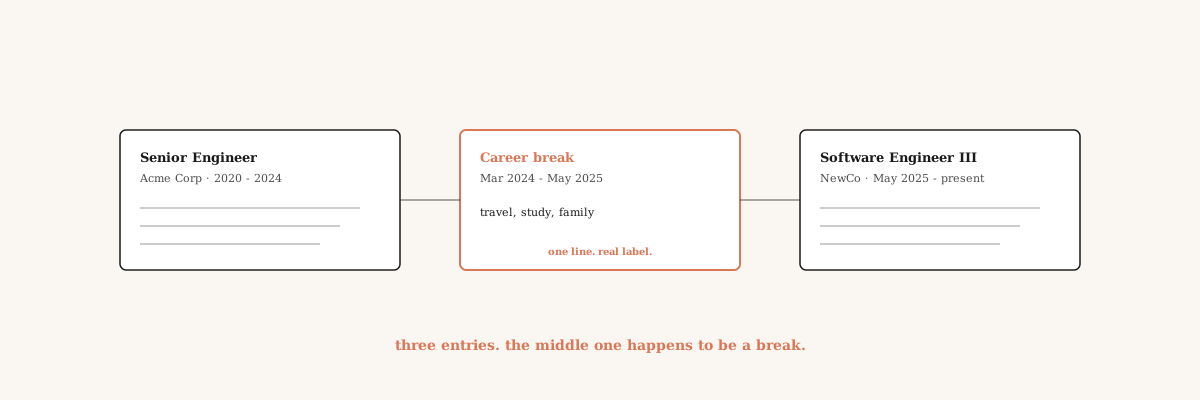
The gap entry should look like any other entry. Same column layout. Same date format. Same font. The visual goal is for the gap entry to not stand out.
Senior Software Engineer, Acme Corp
August 2020 - March 2024

Career break
March 2024 - May 2025

Software Engineer III, NewCo
May 2025 - present
Three roles. Three entries. The middle one happens to be a career break. The recruiter reads it as a normal sequence.
If the gap is longer than 18 months, consider adding one optional line under the gap entry that names a specific activity. One line. Not three.
LinkedIn alignment matters more than ever
In 2026, more recruiters cross-check LinkedIn against the resume than ever before. The gap on the resume needs to match the gap on LinkedIn, and the LinkedIn version needs to look intentional.
Add a "Career Break" entry on LinkedIn
LinkedIn now has a native "Career Break" experience type. Use it. Pick one of the categories LinkedIn offers (caregiving, sabbatical, layoff, travel, learning, health) and let the platform do the labeling work.
Match the dates exactly
The start and end dates of the career break entry on LinkedIn should match the resume to the month. A resume that says "March 2024 - May 2025" and a LinkedIn that says "April 2024 - June 2025" reads as a candidate whose history does not line up. Recruiters notice.
Write a one-line description
LinkedIn allows a description under each entry. Use one line. The same line you might use on the resume, if you used one. Keep them identical.
Do not delete the previous role from LinkedIn
A common mistake is to delete the role that ended badly from LinkedIn entirely, hoping the gap will read as a current sabbatical from the role before it. Recruiters notice. The role exists in LinkedIn's history, in your network's memory, and on the company's old org chart. Deleting it creates a worse problem than leaving it.
What to say in the interview
Three sentences, the same shape as the cover letter line:
- What the gap was for. "I took 14 months off after a layoff to travel and reset."
- What changed in that time. "I got clearer on the kind of work I want next, which is closer to growth than to platform."
- Why this role fits. "The team you are hiring for is doing exactly the kind of growth-experiment work I was already targeting before I saw the posting."
That is the entire answer. Do not add a fourth sentence. Do not explain how productive the time was. Do not list every course you took. The hiring manager wants three sentences and to move on.
Where shortlisted.site fits
The hardest part of writing a resume after a gap is balancing two things: the gap needs to look deliberate without taking over the resume, and the rest of the resume needs to argue for the role you are applying to with the same sharpness as a candidate who never had a gap.
We built shortlisted.site to do both at once. You give us your real history, including the gap, with a label that fits. We generate a tailored resume that lists the gap as a normal entry, and a cover letter that handles the gap in one sentence and spends the rest of its words on the match. The output passes the recruiter scan because the gap stops being the center of the resume and becomes one entry among others.
You can upload your resume and try the first tailoring pass free. No credit card. Try it here.
A gap year on your resume in 2026 is not the disqualifier it used to be. The disqualifiers are vague labels, unexplained jumps, defensive over-narration, and LinkedIn-resume mismatches. Pick a label that matches what actually happened. Put one optional line of context underneath if it helps. Match the LinkedIn entry to the month. Limit the cover-letter mention to one sentence and the interview answer to three.
The recruiter is not looking for an apology and is not looking for a confession. They are looking for a candidate who can describe the last twelve months without flinching, in language that fits the rest of the application. Give them that and the gap stops being the story.