You finished a Bachelor's in economics. Maybe a finance track, maybe not. You did one summer internship at a bank or a corporate finance team. You moved straight into a Master's in Finance at Booth, Kellogg, Columbia, MIT, LBS, or HEC. You graduate next May. You spent the fall recruiting cycle applying to bulge-bracket investment banks and got pattern-matched out for not having a pre-MBA full-time. You are now staring at a buy-side and EB cycle that explicitly prefers candidates with two to four years of investment banking experience.
This is one of the hardest recruiting profiles in finance. It does not show up much in the public job-search forums because the candidates are at top schools and the recruiting happens in private channels. But the volume of these candidates is meaningful and the resume problem is identifiable.
The fix is not to fake the full-time. The fix is to position the candidate correctly for the segment of the buy-side that actually hires from this background.
Why the standard MFin resume fails
The default MFin resume looks like this.
Education
M.S. Finance, Booth School of Business — May 2026 (expected)
B.A. Economics, [University] — May 2024
GMAT 760 / GPA 3.92

Experience
Summer Analyst, [Bulge Bracket] — Summer 2025
- Built DCF models for [sector]
- Supported [transaction] in [region]
- Conducted comparable-company analysis

Earlier:
Summer Intern, [Corporate Finance Team] — Summer 2023
- Bullets

Skills
Bloomberg, Excel, Python, FactSet, VBA
This resume reads, to a buy-side or EB recruiter, as: "MFin candidate, no real full-time, one banking summer, looking for a junior buy-side or EB seat that they will jump from in eighteen months". It is not wrong. It is also not differentiated. There are six hundred resumes like this circulating in any given recruiting cycle.
The recruiter reads it for ten seconds and moves to the next one. The candidate gets the same boilerplate rejection: "We are looking for candidates with two to four years of investment banking experience."
The repositioning strategy
The fix has three layers.
- Pick the segment of the buy-side that hires this profile. Not all buy-side and EB recruiters reject this background. Family offices, sub-scale long-only funds, single-strategy hedge funds with a recent senior departure, EB advisory boutiques in Tier 2 cities, and fundless sponsors will all consider an MFin with strong demonstrable interest. Aim there first.
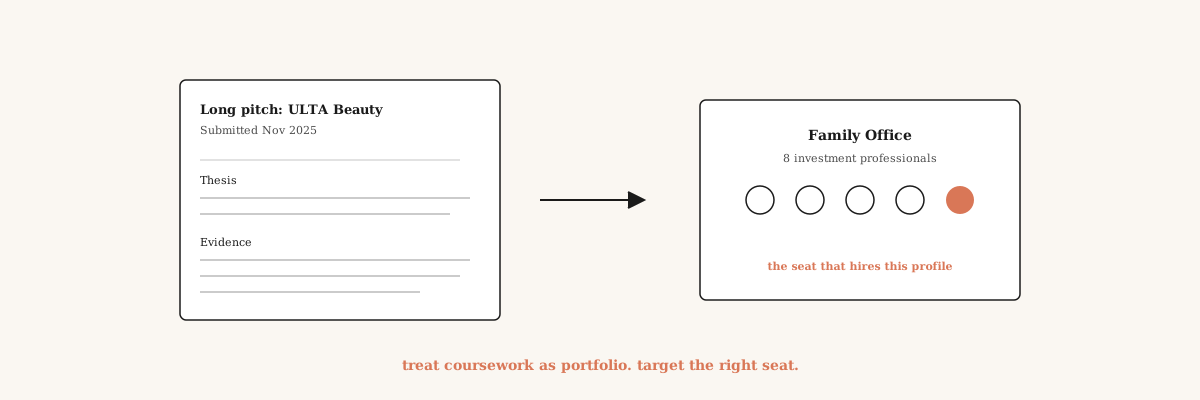
- Treat the MFin coursework, projects, and competitions as portfolio evidence rather than as education. Move them out of the Education section and into a "Selected Projects" or "Investment Work" section that reads like experience.
- Lead with one specific investment thesis, not a list of skills. A candidate who can credibly walk through one stock pitch or one credit thesis with conviction is hireable. A candidate with a list of skills and no demonstrated thinking is not.
Here is how each layer plays out on the resume.
Repositioning move 1: pick the right targets
Buy-side and EB segments that actively hire MFin-with-no-full-time:
Family offices
A family office is a private investment vehicle for a single wealthy family or a small group of families. They typically run lean (three to fifteen investment professionals) and hire on judgment and fit rather than on pedigree. They are not on the formal MBA recruiting calendar. You find them through alumni networks, the Family Office Exchange, the FOX Family Office List, and direct outreach.
The resume for a family office should emphasize: ability to think across asset classes, comfort with private and illiquid investments, willingness to do generalist work (the same person sources deals, models, and tracks portfolio companies), and a real interest in long-duration capital. They explicitly do not want you to act like a banker.
Sub-scale long-only funds
Funds with $200M to $2B AUM, often with a regional or sector focus. They hire one or two analysts a year and do not run formal recruiting. They take MFin candidates who can demonstrate one or two strong investment ideas in their target sector or geography. The MFin name helps but is not sufficient. The investment work is what gets the interview.
Recently-spun-out hedge funds
A senior PM leaves a big shop to start their own fund. They need to hire one or two analysts in the first year. They cannot afford to pay banking-PA-equivalent for two-to-four-year banking experience. They will hire an MFin who can demonstrate they can pull weight on one specific sector or strategy from week one. These funds are the highest-effort path because finding them requires real legwork (industry press, alumni networks, headhunter relationships).
EB advisory in Tier 2 cities
Houston energy practices, Denver natural-resources practices, Atlanta industrials, Chicago middle-market healthcare. These shops cannot recruit at the same level as the New York EBs. They will take MFin candidates who can demonstrate sector-specific interest and analytical skill.
Fundless sponsors
Independent sponsors who source deals and bring them to LPs deal-by-deal. They often run with two or three investment professionals plus an MFin associate. They are looking for someone who can model deals, manage diligence streams, and hold their own with management teams. Less competitive than mainstream PE.
Investment teams at endowments and foundations
University endowments above $1B, foundations like the Gates Foundation, sovereign wealth allocator teams. They hire one or two MFin associates a year. The work is asset allocation and manager selection rather than direct investing, but the seat is hard to get and the skill build is unique.
Repositioning move 2: build a real "Investment Work" section
This is the highest-leverage change to the resume. Most MFin resumes bury coursework projects in a one-line "Selected Projects" footnote at the bottom. The repositioned resume puts a full "Investment Work" section above the work-experience section, with three or four substantive entries.
Each entry should look like a real piece of investment work, not like a school project.
Investment Work

Long pitch: [Specific company name and ticker] — November 2025
Submitted to the [School] Investment Club's stock-pitch competition; placed 2nd of 47.
Thesis: [One sentence].
Key evidence: [Three or four bullets with actual data points].
Outcome: Stock has moved [X]% since pitch versus [Y]% for the sector index.

Credit pitch: [Specific bond and CUSIP] — February 2026
Coursework project for [Class]; presented to [Professor or guest speaker].
Thesis: [One sentence].
Key evidence: [Bullets].

Sector deep-dive: [Sector and geography] — March 2026
Independent project for [Capstone] focused on [specific sub-thesis].
Outputs: [Specific deliverables — model, white paper, etc.].
Notice what this section does. It treats coursework as primary experience, not as education. It uses the same shape as a junior investment professional's "Recent Work" section. Recruiters reading it can evaluate the candidate's investment thinking directly, rather than inferring it from the GPA.
Two principles for this section.
Pick real names
Do not write "long pitch on a large-cap consumer staples company". Write the company name. The recruiter who has heard you might be interesting will pull up the ticker and form their own view of whether your thesis is a good thesis.
Show outcomes when you can
If you pitched a long in November and the stock has outperformed the sector since, write that. If it has underperformed, write that too — recruiters value candidates who track and own their picks. If it is too soon to know, mark it as "outcome pending" rather than removing the entry.
Repositioning move 3: replace the skills section with an investing philosophy paragraph
The skills section on a default MFin resume ("Bloomberg, Excel, Python, FactSet, VBA") is functionally noise. Every MFin candidate has these. Listing them does no work.
Replace the skills section with a two-sentence investing-philosophy paragraph at the top of the resume.
"Long-biased generalist investor focused on consumer and industrial mid-caps. Most interested in capital-allocation decisions: identifying companies whose management is reinvesting cash flow against a non-consensus thesis with a clear endpoint."
This is harder to write than a skills list. It is also the most differentiating thing on the resume. Recruiters read it and form an immediate sense of what kind of investor the candidate wants to be. If the philosophy aligns with the firm's mandate, the resume gets pulled out of the pile.
Three rules for the philosophy paragraph.
- Be specific. "Long-biased generalist" is too generic. "Long-biased generalist focused on consumer and industrial mid-caps" is specific enough to engage a sector recruiter. "Special-situations equity investor focused on industrial spinoffs" is even better.
- Pick a real point of view. Not every philosophy works. "Capital-allocation focus" is a real and recognized framework. "ESG-aligned long-only" is real and currently has tailwinds and headwinds. "Mean-reversion macro" is real. "Generalist value with quality bias" is real. Pick something you actually believe and can defend.
- Match the philosophy to the targets. The philosophy paragraph should align with the segment you are targeting. If you are targeting family offices, lean toward long-duration, capital-allocation framings. If you are targeting EB advisory, lean toward sector or transaction expertise.
What to do with the banking summer
If you did a bulge-bracket banking summer, that experience is the strongest single line on your resume for buy-side and EB targets. Three rules.
Lead the work-experience section with it
Even if it was a 10-week summer, list it before any earlier internships. The buy-side recruiter is looking for one signal: have you been close to real deal work and real client interaction? The banking summer is that signal.
Use deal names if you can
If your summer involved any live deals, use the deal name and your role on it. "Supported the [Company A] / [Company B] $1.2B carve-out, focused on financial diligence and management presentations." Be careful with confidentiality — anything that has been publicly announced is fine to mention.
Do not pretend it was longer than it was
A 10-week summer is a 10-week summer. Listing it as "Summer 2025 - Fall 2025" or "10+ weeks at [BB Bank]" tries to compensate and reads as inflation. Honest dates and strong content do more work than stretched dates.
What to do with the MFin name
The MFin program name does work, but only when it is the first thing the resume's geography and sector targeting allows you to reach. A Booth MFin signals to a Chicago family office. A Columbia MFin signals to a New York family office. An LBS MFin signals to a London EB.
Two principles.
Lead with the program name on regional applications
For a Chicago family office, the resume's Education section should be the second item the recruiter reads, not the fourth. The program name carries the candidate.
De-emphasize the program name on long-shot applications
For a Houston energy EB or a Denver natural-resources fund, the Booth name does less work than a clear sector-specific investing philosophy and one or two strong sector-specific projects. Move the Education section below the Investment Work section. The candidate's work, not the school, has to carry the resume.
The cover letter for buy-side and EB
A two-paragraph cover letter, short and specific.
Paragraph 1: Name the firm, name the recent thing they did
"I am applying for the analyst role on the [Firm]'s consumer team. The piece you published in November on private-label consolidation in beverages is what made me want to send this — the framework you laid out for evaluating shelf-space defensibility against margin pressure is the same framework I have been using to evaluate [Company X], which I pitched at the [School] investment club this past semester."
This paragraph signals two things. You read the firm's work. You have done work that engages with the firm's thinking. Buy-side and EB recruiters get a hundred generic cover letters; the one that names a specific recent piece of the firm's output gets pulled.
Paragraph 2: Name your investment philosophy and one specific match
"My investment focus is consumer mid-caps, with an emphasis on capital-allocation decisions and management quality. Two pieces of work I would point you toward: a long pitch on [Company X] from November 2025 and a sector deep-dive on private-label dynamics from March 2026, both of which I can share. I would be glad to walk through either."
The cover letter is offering work, not pitching the candidate. The recruiter who reads this and is interested asks for the deck. That is the right shape.
What not to do
Do not list every coursework project
Three or four substantive projects are stronger than ten thin ones. Quality of thesis matters more than quantity.
Do not list certifications you have not completed
CFA Level 1 means CFA Level 1. CFA Level 1 in process means in process, list the exam date. CFA candidate alone is meaningless. Be specific.
Do not bury your investment club involvement
If you are the head of stock pitches at the school's investment club, that is a leadership signal that buy-side recruiters value. List it as a substantive entry, not as an extracurricular.
Do not pretend to be a banker
If you only did one banking summer, do not write your resume as if you are a junior banker. Buy-side recruiters can tell. Write your resume as an investor-in-training who has banking exposure. Different positioning, different fit.
Where shortlisted.site fits
The MFin-with-no-full-time resume is a positioning problem more than a content problem. You have the substance. The substance just needs to be arranged for the segment of the buy-side that actually hires this profile, with an investing philosophy that connects the rest of the page.
We built shortlisted.site to do exactly this kind of repositioning. You give us your real history, your coursework projects, your investment club work, the banking summer, the philosophy you can defend. We generate a tailored resume that leads with the Investment Work section, frames the banking summer correctly, and points at the segment of the buy-side or EB the firm sits in. The cover letter follows the two-paragraph offer-of-work pattern.
You can upload your resume and try the first tailoring pass free. No credit card. Try it here.
The MFin-with-no-full-time profile is not a disqualifier. It is a positioning problem with a small number of segments where the positioning works. Family offices, sub-scale long-only funds, recently-spun-out hedge funds, EB advisory in Tier 2 cities, fundless sponsors, and endowment investment teams all hire this profile in normal years.
Move the coursework into a real Investment Work section. Replace the skills list with an investing philosophy paragraph. Lead the banking summer with deal names. Keep the cover letter to two paragraphs that offer real work to look at. Target the firms that hire this profile rather than the ones that do not.
The candidates who get the seats in this profile are the ones whose resume reads as "investor-in-training with conviction" rather than "MFin with no banking experience". Same person. Different resume.