Open any 2026 job-search advice thread on r/jobs, r/cscareerquestions, or LinkedIn and you will find two contradictory pieces of guidance, often from the same source.
- Mirror the JD's language. ATSes rank you on overlap with the job description, so use the JD's exact phrasing in your bullets.
- Don't keyword-stuff. Recruiters can tell, ATSes are sophisticated enough to penalize it, and your resume will read like a parody.
Both pieces of advice are correct. Both also leave the candidate without a usable rule for what to actually do. The result is the most common tailoring failure: candidates either rewrite their bullets to mirror so heavily that the resume reads as an obvious imitation, or they refuse to mirror at all because they fear the keyword-stuffing penalty.
The right answer is in the middle, but it has a shape. Four rules.
Rule 1: Mirror at the phrase level, not the term level
The instinct most candidates have when "mirroring the JD" is to scan the JD for individual words and substitute them into their bullets. This is the version that becomes keyword-stuffing.
A better mental model: the JD is written in phrases that describe activities and outcomes. Recruiters who have written or read the JD a hundred times have a sense of which phrases are the actual hiring criteria and which are filler. Mirror the phrases, not the individual words.
Example: a JD bullet
"Drive activation experiments across the new-user funnel, partnering with data science to size opportunities and engineering to ship fast."
The naive keyword-stuffing version of mirroring picks out "activation", "experiments", "new-user funnel", "data science", "engineering", and substitutes them in.
"Activation experiments on the new-user funnel with data science and engineering."
This reads as a list of words. It is also lower-quality than the original because it strips out the verbs.
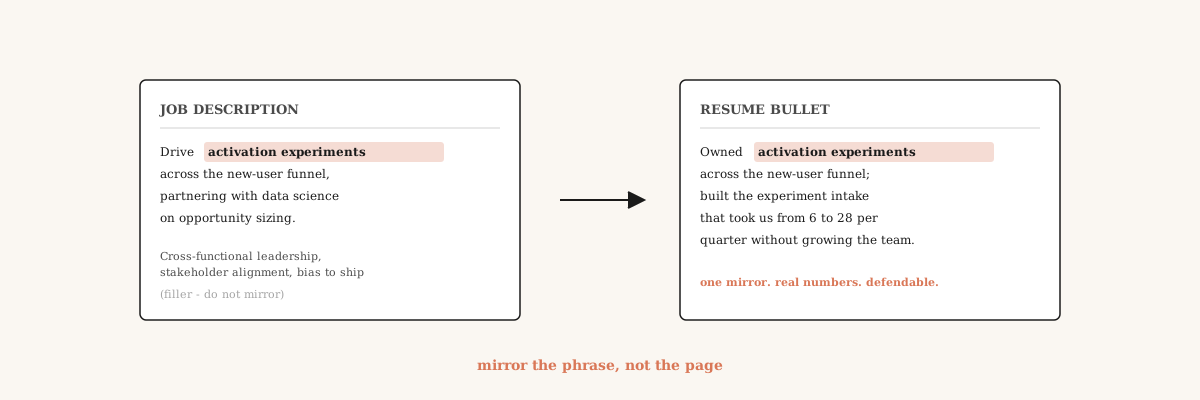
The phrase-level mirror picks the phrase "activation experiments across the new-user funnel" and uses it in a bullet where it is true.
"Owned activation experiments across the new-user funnel; partnered with data science on the experiment-sizing framework and shipped 14 experiments in two quarters with the engineering team."
The mirror is one phrase, used in a bullet that has its own structure, verbs, and numbers. The recruiter reads the bullet and sees both the phrase that signals fit and the supporting evidence.
This is the difference between ATS optimization that works (the phrase is captured by the ATS's overlap scoring) and ATS optimization that backfires (the resume reads as a list of substituted words).
Rule 2: Mirror only in the top three bullets of your most recent role
The second rule limits how much of the resume gets mirrored. Most candidates over-mirror. They mirror every bullet on every role. The result is a resume that sounds like a transcript of the JD with names changed.
The actual mirror surface is small. Four locations.
- The summary line. One mirror, if the candidate has a summary.
- The top three bullets of the most recent role. Mirror in two of these three at most.
- The cover letter's first paragraph. One or two phrases.
- A relevant section title, if you use one. "Selected projects in growth experimentation" can mirror a JD that emphasizes experimentation.
That is the entire surface. Roles older than the most recent one should be left alone. Side-project sections should be left alone. The skills section, if you have one, should not be a mirror surface.
The reason this works: ATSes weight the top of the resume heavily. The recruiter scans the top half page in seven seconds. Both the machine and the human read primarily the top of the most recent role. Mirroring there captures most of the value. Mirroring the rest of the resume captures very little additional value and creates the keyword-stuffing penalty.
Rule 3: Mirror twice, not eight times
The third rule limits how much you mirror in any one location. Most over-mirroring happens because the candidate sees a phrase in the JD, mirrors it once, then sees a related phrase, mirrors that too, then sees another related phrase, mirrors that as well. By the third mirror in a single bullet, the bullet has stopped being a description of the candidate's work and has become a recombination of the JD.
The discipline is: pick one phrase per bullet. Two at most. Never three.
Example: the JD
"We are looking for a senior product manager to drive activation experiments across the new-user funnel, partnering with data science on opportunity sizing, engineering on velocity, and design on the experimentation surface itself. Cross-functional leadership, stakeholder alignment, and a bias toward shipping are critical."
A bullet with five mirrored phrases is over-mirrored.
"Drove activation experiments across the new-user funnel, partnering with data science on opportunity sizing, engineering on velocity, and design on the experimentation surface, with cross-functional leadership and a bias toward shipping."
It reads as a transcription of the JD. The candidate's actual work is not visible.
A bullet with one mirrored phrase has the right balance.
"Drove activation experiments across the new-user funnel; built the experiment intake and review process that took us from 6 to 28 experiments per quarter without growing the team."
One mirror, plus the candidate's specific contribution, plus a number. This is the version that lands with both the ATS and the human.
A bullet with two mirrored phrases is acceptable when both phrases are central.
"Drove activation experiments across the new-user funnel and partnered with data science on opportunity sizing for the activation roadmap; shipped 14 experiments in two quarters with measurable lift on activation."
Two mirrors plus a number. This is the limit.
The simple test: read the bullet aloud. If it sounds like you wrote it, it is okay. If it sounds like you were trying to use specific words, it is not.
Rule 4: Mirror only when the bullet is true
The fourth rule is the most important and the most often broken. Mirror only on bullets where the underlying experience genuinely matches the phrase you are mirroring.
If the JD says "drove activation experiments across the new-user funnel" and you have actually run activation experiments across a new-user funnel, mirror it. If you have run experiments but not on the new-user funnel — your experiments were on the activated-user retention funnel — do not mirror that phrase. Use the true phrase ("retention experiments on activated-user cohorts") instead.
This rule sounds obvious. The reason it is broken so often is that mirroring on bullets you cannot defend is the difference between a tailored resume that earns the interview and a tailored resume that loses the interview.
Recruiters who pull a candidate based on a mirrored phrase ask about it in the screening call. If the answer is solid ("yes, we ran those experiments, here is the framework, here are the numbers"), the candidate advances. If the answer is fuzzy ("well, my work was related, but it was actually a different funnel"), the recruiter reads the resume more skeptically from that point on. Three minutes into the call, the candidate has lost the interview because of one phrase that should not have been mirrored.
The rule: never mirror a phrase you cannot defend in a follow-up question. If the closest you can get is a related concept, use the related concept's true phrase rather than the JD's exact phrase. The ATS will pick up the related concept on its own through synonym detection. The human will respect the precision.
What to do when the JD says things you have not done
Sometimes the JD's most important phrase is something you genuinely have not done. The role looks for "data infrastructure migration experience" and you have not migrated data infrastructure. The role wants "fundraising leadership" and you have not led a fundraising round.
Two options.
Option 1: Apply for a different role
The resume tailoring is downstream of the candidate-role fit. If the JD's central requirement is something you have not done, the resume cannot solve it. Move on to a different role where the central requirement does match.
Option 2: Address the gap directly in the cover letter
If the requirement is one of three or four important things and the others match, mirror the others on the resume and address the gap in the cover letter.
"I want to be upfront that I have not led a formal fundraising round. The two-year stretch where I owned our financial planning and external-investor relationships at [Company] gave me direct exposure to the underlying work — pitch decks, due diligence streams, investor questions, board prep — but I have not been the formal lead. The other elements of this role I have done at scale, and I am ready to step into the fundraising lead position."
This is honest and signals self-awareness. Recruiters reading it form a clearer view of the candidate's actual fit than they would from a mirrored bullet that overclaims.
Common mirror failures
Failure 1: Mirroring the soft skills
JDs often list soft skills like "cross-functional leadership", "stakeholder alignment", "bias toward action", "comfortable with ambiguity". Mirroring these in your bullets backfires. They are filler in the JD and they are filler in the resume. They make the resume read as keyword-stuffed without adding any signal.
Skip the soft-skill mirrors. Mirror the activity and outcome phrases. The soft skills come through in the bullets' verbs and in the cover letter.
Failure 2: Mirroring the section header
Some candidates add a section header to the resume that mirrors the JD. "Cross-Functional Leadership" or "Stakeholder Alignment" as a resume section. This reads as desperate. Recruiters skip past it.
Failure 3: Mirroring the company's mission statement
Some JDs include a company-mission paragraph at the top. Candidates sometimes mirror language from the mission ("we believe in customer-obsessed product development") into the resume's summary. The recruiter reads it and it sounds like flattery, which it is. Skip it.
Failure 4: Mirroring across multiple JDs in a single resume
If you are applying to several similar roles and writing what is roughly the same tailored resume, do not pile up phrases from all of them in a single resume. Each tailored resume should mirror that specific JD. The phrases that appear in multiple JDs at once tend to be the soft-skill filler. Mirror only the JD-specific phrases.
How to actually find the phrases worth mirroring
Most candidates open the JD and try to read the whole thing for mirror candidates. This is inefficient. Three places to look first.
Place 1: The first three responsibilities
JDs are written with the most important responsibilities at the top. The first three bullets under "Responsibilities" or "What you'll do" are the JD's signal of what matters. Mirror from there, not from the bullet at position eight.
Place 2: The activity verbs
Inside each top-three responsibility, look at the verbs. "Drive", "lead", "own", "design", "ship", "build", "grow", "scale". The phrases that include these verbs are usually the mirror-worthy ones. The phrases that do not (descriptive padding around the verb) usually are not.
Place 3: The repeated phrases
If a phrase appears in both the responsibilities section and the requirements section, that phrase is heavily weighted in the JD. Mirror that phrase first.
Three places. The whole exercise should take about ninety seconds. If you are spending fifteen minutes on the JD, you are doing it wrong.
Where shortlisted.site fits
Mirroring the JD without keyword-stuffing is the single hardest thing to do well in a tailored resume. The four rules above sound simple. Applying them on a real JD with a real resume, ten times a week, while also doing the rest of the application work, is exhausting. Most candidates either over-mirror or under-mirror, and they do not have a feedback loop to know which one they are doing.
We built shortlisted.site to do this exact mirroring work for you. Our fit analysis reads your real resume and the JD, then identifies the phrases in the JD that you can defensibly mirror given your actual experience. The tailored resume we generate uses one or two of those phrases in the top three bullets, in their natural context, with your numbers attached. We do not mirror phrases you cannot defend. We do not mirror more than the rules above allow.
The result is a resume that lands as a mirror to the ATS and reads as your work to the human. Most users see their interview rate climb to roughly the rate of candidates who genuinely match the role exactly, because the mirror is doing the work of making the genuine match legible in a seven-second scan.
You can upload your resume and try the first tailoring pass free. No credit card. Try it here.
Mirror the JD at the phrase level, not the term level. Mirror only in the top three bullets of the most recent role and the cover letter's first paragraph. Mirror twice, not eight times. Mirror only on bullets you can defend in the screening call.
That is the entire system. The resume that follows these four rules captures most of the ATS-optimization value, avoids the keyword-stuffing penalty, and does not lose the interview when the recruiter asks a follow-up question on a mirrored phrase.
The point of mirroring is not to fool the ATS. The point of mirroring is to make the genuine match between your experience and the role legible in the seven seconds the recruiter has. If your work actually matches, the right mirror surfaces the match faster. If it does not, no amount of mirroring will help, and the right move is to apply for a different role.