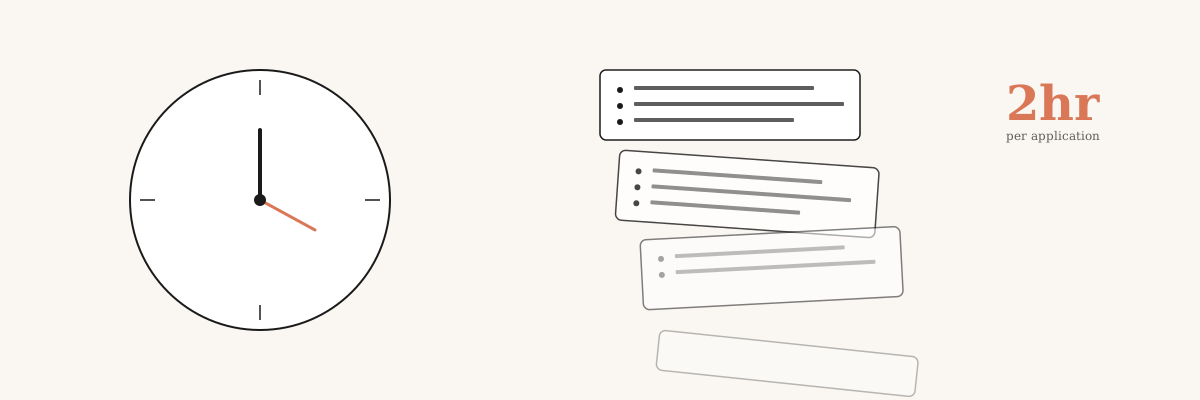
You've heard the advice a thousand times: "Tailor your resume to every job."
Then you try to actually do it. You open the job description. You open your resume. You open your cover letter from last time. You rewrite the summary. You reorder the bullets. You re-read the JD to check your keyword density. You rewrite the cover letter. You save it as a new file. You upload it. You fill in 14 screening questions. You stare at "why do you want to work here?"
Two hours later, you've submitted one application.
Ten applications in, it's Sunday night and you've spent the entire weekend on it. You haven't even heard back from last weekend's applications. You don't know if tailoring is working. You can't tell if the effort is landing or if you're just performing diligence for an empty room.
There is a name for this on the job-search forums now: tailoring fatigue. It is one of the top three stated reasons people quit active job searches and start spray-and-praying Easy Apply instead.
How real is this, exactly
The numbers, from various 2025 surveys and Reddit venting threads:
- 73% of job seekers report emotional exhaustion during their search. The single most-cited cause is the per-application tailoring workload.
- Top-rated threads on r/jobs and r/careerguidance titled "I hate tailoring my resume" appear nearly monthly and gather thousands of upvotes.
- Glassdoor's 2025 job-hunting community has this as one of its most-discussed topics: "Tailoring is constantly recommended. Scaling it across 20+ applications a week is impossible."
- Career coaches and recruiters (rightly) report that tailored applicants get 2–3x more interviews than generic ones. That's true. It's also the source of the fatigue — the advice is technically correct and operationally unsustainable.
The truth both sides refuse to say out loud: tailoring works per application, but the math breaks if you try to apply to 20 roles a week this way. You will burn out. You will start to hate the search. You will eventually give up and mass-apply.
Why the usual advice doesn't scale
Here's the standard playbook you'll find on LinkedIn or in career-coach content:
- "Match the keywords in the job description."
- "Rewrite your summary for each role."
- "Tailor your top 3 bullets."
- "Use a cover letter that specifically addresses the company."
- "Answer 'why this company' with real research."
Each of those is good advice for one application. Multiply it by 20 and you've built yourself a second job. Which is the cruel irony — you're already unemployed or trying to leave a job you hate, and the solution is to spend 30 hours a week on tailoring.
The 80/20 of tailoring
Most of the effort in a typical tailored application doesn't move the needle. Here's what actually matters, in order:
1. The top half of the first page (80% of the impact)
A recruiter scans your resume for about 7 seconds before deciding yes/no. They're looking at:
- Your name and current title
- Your summary/headline (if you have one)
- Your most recent role's title and company
- The first 2–3 bullets under that role
- Your years of experience
Everything after that half-page is read only if the top half hooks them. Tailor the top half hard. Leave the rest alone.
2. Matching the JD's language in your top bullets (15% of the impact)
Not the JD's wishlist of skills — its phrasing. If they say "cross-functional leadership," write "cross-functional leadership" in a bullet where you actually did that. If they say "stakeholder alignment," write "stakeholder alignment." The ATS is literal; the recruiter's skim is pattern-matching. Mirroring their language twice in your top bullets is worth more than rewriting your entire experience section.
3. The cover letter's first paragraph (5% of the impact)
Recruiters who read cover letters read the first paragraph. They read it to decide whether to read more. Nail the first paragraph — name the role, name one specific thing about the company, explain in one sentence why this specifically fits your trajectory — and the rest of the letter can be a lightly edited version of your standard template.
What doesn't matter
- Rewriting every bullet on every role (recruiters don't read past the top of your current job)
- Perfect keyword density across the whole resume (the ATS checks presence, not density)
- A custom four-paragraph cover letter (nobody reads past paragraph one unless paragraph one was good)
- Changing fonts, layouts, margins (stop — nobody cares)
- Filling out optional profile sections on company portals (rarely read)
You can do a 10-minute tailoring pass that captures 95% of the value. The remaining 5% comes from another 110 minutes of effort. That is the math of diminishing returns, and it is the math most job-search advice refuses to do out loud.
A sustainable tailoring workflow
Here's what fast tailoring actually looks like:
Step 1: Read the JD once. Highlight the top-third responsibilities and the top 5 required skills. (3 minutes.)
The top third is usually the first cluster of bullets under "Responsibilities" or "What you'll do." Everything below is secondary. The top 5 skills are the ones listed first or mentioned most often.
Step 2: Rewrite your summary to lead with the 2 strongest matches. (2 minutes.)
One sentence. Name the seniority level. Name the two domains where you match hardest. Don't improvise — pull from existing summaries you've written.
Step 3: Reorder the top 3 bullets on your current role so the strongest JD-matches come first. (2 minutes.)
You're not rewriting. You're reordering. Bullet 1 should demonstrate the JD's #1 responsibility. Bullet 2 should demonstrate #2. Bullet 3 is flex.
Step 4: Mirror the JD's language in those top 3 bullets where it's true. (2 minutes.)
"Cross-functional leadership" → use that phrase. "Stakeholder alignment" → use that phrase. Don't fabricate. Don't translate.
Step 5: Write or copy a 3-paragraph cover letter. Customize only the first paragraph. (3 minutes.)
Paragraph 1: Role, company, why this specifically. Paragraph 2: Your two strongest matches, with one concrete result. Paragraph 3: Close with enthusiasm + call to action.
Step 6: Submit. Do not re-read it four times. (1 minute.)
Total: 13 minutes per application. Ten applications in just over 2 hours. That's sustainable.
What to stop doing
- Stop rewriting every bullet on every role. Your 2018 role at your second job is not getting read. Leave it alone.
- Stop writing 4-paragraph cover letters. Nobody reads paragraph 4.
- Stop researching the company for 20 minutes. Skim the About page. Note one specific thing. Move on.
- Stop filling in every optional field on the application portal. You are not being scored on completeness, you are being scored on your resume.
- Stop re-reading for typos 6 times. Twice is enough. Three times is anxiety, not diligence.
Where shortlisted.site fits
Tailoring fatigue exists because the tools assume you want to do it manually. They make you copy-paste between a job description, a resume draft, and a cover letter template — and the labor compounds every time.
We built shortlisted.site to compress that 13-minute workflow into about 5 minutes without becoming generic. You point our AI at a job posting. It analyzes the fit first — telling you whether this role is worth tailoring for or whether you should skip it. Then, for the roles where you actually rank, it generates a tailored resume and a tailored cover letter from your existing profile, mirroring the JD's phrasing where your experience genuinely matches.
The output isn't a generic ChatGPT rewrite. It's informed by a real multi-dimension fit analysis, so the resume emphasizes the things that actually match and skips the things that don't. You review, edit where you want, and submit. 5 minutes per serious application. 10 serious applications a week instead of 3.
Our users typically cut their per-application time by 70% and increase their interview rate — because the applications they do send are better-targeted.
You can upload your resume and try the first tailoring pass free. No credit card. Try it here.
Tailoring works. But the way you have been told to do it does not scale, and the job-search advice industry has been lying by omission about this for years.
The fix is not "try harder." It's to tailor the 20% of the document that matters and leave the rest alone. 13 minutes per application, not 90.
Do that for the roles where you genuinely rank. Skip the roles where you don't. Stop burning your weekends on effort that the recruiter was never going to read anyway.